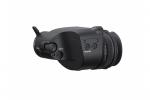
The Sony VENICE MPC-3610 is a full-frame digital cinema camera from the CineAlta range with 6K sensor resolution. The specific design of this camera and the absence of any broadcast adapter to organize the VENICE MPC-3610 into a multi-camera path for studio TV workflows indicate VENICE's specialization as a camera for film or field TV production only. Note that for its predecessor, the Sony PMW-F55, this capability existed in conjunction with the CA4000 camera adapter. However, VENICE still has the option to go to the camera control menu, which allows you to control camera settings familiar to television. For example, you can use units of sensitivity of the camera in decibels or call up the TV's familiar Paint Menu with all its extensive picture parameter settings. In terms of technical and performance characteristics, Sony VENICE has confidently taken the first place in the cinema market among professional cameras for filming made by Sony and surpassed the previous generation of Sony flagships such as the F65 and PMW-F55. The Sony VENICE camera supports HDR (High Dynamic Range) technology and is classified as HDR-compatible large sensor cameras.
Considering the size of the camera sensor 36.2x24.1mm, our VENICE can be equipped with different lens mounts to choose from PL, LPL and a PV to LPL adapter at your request. A new, very useful function of the camera for shooting is the ability to replace the internal ND filter of almost all required density levels (Clear; 0.3; 0.6; 0.9; 1.2; 1.5; 1.8; 2., 1; 2.4) using automation. VENICE is the first camera in its class with an eight-stage ND filter servo built into the camera body. This advantage of the camera eliminates the need to spend time changing the settings of external filters. The number of internal filters also greatly increases VENICE's operational flexibility by controlling the camera remotely while on drones, cranes or underwater boxes. According to the manufacturer, the idea was implemented thanks to the know-how in the development of a special electromechanical design by the company's engineers, consisting of mutually rotating, according to a specified algorithm, two rings with frame windows of a certain density, which intersect, resulting in the desired total density of the light filter.
The special design of the camera together with the CBK-3610XS adapter allows separating and carrying out on a cable, up to 5.5 m, the sensor and filter unit, which, by itself, is much lighter and more compact than the rest of the massive part of the camera structure. This procedure can be easily performed on set, thus lightening the weight of the camera for handheld shooting and filming with lightweight stabilization systems.
The presence of two basic sensitivities in the camera, ISO 500 and 2500, allow you to adapt to shooting in high and low light at no additional cost. Depending on the set base sensitivity, a different range of exposure index is offered for selection; they provide for a change in sensitivity in a fairly wide range.
The camera's claimed high dynamic range of 15+ apertures can be transmitted in video footage using linear 16-bit RAW SQ at 4K resolution or X-OCN (16-bit eXtended tonal range Original Camera Negative) at 6K. The latter format is divided into several versions available for selection (X-OCN XT; X-OCN ST; X-OCN LT), which, in descending order according to this list, require a lower bitrate relative to each other, and this leads to a slight difference in quality images of each format. The main advantage of the X-OCN formats is the size of the resulting file, which has a reasonably high image quality and is relatively compact. For example, the X-OCN XT is comparable to the Sony RAW file size, and the X-OCN LT is comparable to the XAVC 4K Class480 file size, given the fact that the X-OCN LT supports 16-bit data format as opposed to XAVC 4K Class480, which has 10 bits. To record video in these formats, the camera is equipped with a portable recorder AXS-R7 and two AXSM memory cards of 512 GB each. For comparison, in RAW SQ format at a maximum resolution of 4K 17: 9 and a recording rate of 25 fps, you can record 63 minutes of video on a 512 GB card, while in X-OCN XT format at the same resolution and the same speed, you can record 62 minutes. However, already at 6K 17: 9 resolutions and the same speed with the X-OCN XT recording format, you can only record 28 minutes.
Together with the AXS-R7 video recorder or without it, Sony Venice can record on SxS PRO/PRO+ memory cards in one of the selectable video formats:
XAVC-I Class480 (4K, QFHD)
XAVC-I Class300 (4K, QFHD)
MPEG HD422 (HD)
Apple ProRes 422 HQ (HD)
Apple ProRes 422 (HD)
Apple ProRes 422 Proxy (HD)
Apple ProRes 4444 (HD)
It supports simultaneous recording to AXSM and SxS memory cards for most of the above video recording formats. Since the camera does not support all of the specified formats and frame rates in this mode, at the pre-production of filmmaking, it is advisable to check about its capabilities in terms of compatibility of the declared recording formats, frame rates and formats with our managers. Since the camera does not support all specified formats and frame rates in this mode, it is recommended to discuss its capabilities in terms of compatibility of the declared recording formats, frame rates and formats with our managers at the pre-production of filmmaking. In addition, the camera supports simultaneous recording in two selectable video formats on one SxS memory card. For example, you can choose to record 4K XAVC-I Class480 as the primary format and MPEG HD422 P or ProRes 422 Proxy P as the secondary ones. These seemingly insignificant advantages in the operation of the camera allow you to carry out rough editing of the footage right on the set without the additional expense of powerful hardware resources. Since the video formats MPEG HD422 P or ProRes 422 Proxy P are less resource-intensive, they will require relatively low costs to work with them.
Sony VENICE camera is capable of supporting almost all standard base frame rates (23.98 / 24/25 / 29.97 / 47.95 / 50 / 59.94), and for shooting you can choose frame rates from the range: 1 - 60, 66, 72, 75, 88, 90, 96, 100, 110, and 120. The following aspect ratios are supported and offered for shooting:
6K 6048×4032 3:2 35,9×24,0 mm;
6K 6054×3272 1.85:1 36,0×19,4 mm;
6K 6054×3192 17:9 36,0×19,0 mm;
6K 6048×2534 35,9×15,0 mm 2.39:1;
5.7K 5674×3192 33,7×18,9 mm 16:9;
4K 4096×3432 24,3×20,4 mm 6:5;
4K 4096×3024 24,3×18,0 mm 4:3;
4K 4096×3024 24,3×18,0 mm 4:3 Surround;
4K 4096×2160 24,3×12,8 mm 17:9;
4K 4096×2160 24,3×12,8 mm 17:9 Surround;
4K 4096×1716 24,3×10,3 mm 2.39:1;
3.8K 3840×2160 22,8×12,8 mm 16:9;
3.8K 3840×2160 22,8×12,8 mm 16:9 Surround View.
Before starting the filming process, it is advisable to clarify the compatibility of the recording formats with the formats and frame rates provided in the camera for selection with our managers in order to avoid possible inconsistencies in the operation of the camera already on the set. Like the Sony PMW-F55 camera, the Sony VENICE MPC-3610 has the ability to select the brightness characteristics and color space that will be captured during recording, and is also assigned separately for the various video outputs of the camera (S-Gamut3.Cine/SLog3 / S-Gamut3/SLog3 / [HLG(Natural) / HLG(Live) / Rec.2020/User Gamma / Rec.709/User Gamma]). One of the innovations in this direction is the support in VENICE of the Hybrid Logarithmic Gamma (HLG (Natural) / HLG (Live)), which is used to provide HDR technology. You can also choose to view the brightness characteristic and color space from several suggested categories for this. The list of categories for viewing images, in addition to those already known from previous cameras (Preset Look, User 3D LUT, ASC CDL Process), also includes the ability to view an image using some ACES profiles (see table) and a new function first proposed by Sony for a camera VENICE, Advanced Rendering Monitoring (ART). The ART file is created from a User 3D LUT file using the free RAW Viewer and results in a significant improvement in image quality when applied. The brightness characteristics and the covered color space that can be set in Sony VENICE are shown in the table.
|
Category selection
|
Display characteristic name
|
Description
|
|
Preset Look
|
s709
|
This viewing characteristic translates the brightness for the correct contrast color map in the Low Contrast and Cinematic areas. It provides subtle and well-reproduced skin tones with a tonal curve similar to film characteristics and low contrast
|
|
R709(800%)
|
The luminance characteristic for which a dynamic range is extended up to 800% due to light compression in the bright area of the dynamic range, which is defined by a value from 70% to 800%, using the ITU-R709 standard as a basis in the characteristic
|
|
S-Gamut3.Cine/SLog3
|
Color space that can be easily adapted to DCIP3 digital cinema requirements
|
|
S-Gamut3/SLog3
|
The large color space is optimized by original Sony image distortion correction technology and adapted to the future standardized color space
|
|
ACES
|
ACESproxy
|
Logarithmic curve and wide color space (AP1) set by the Academy Color Encoding System (ACES)
|
|
ACEScct
|
Wide color space logarithmic profile (AP1), based on the ACESproxy profile and having a defined lower luminance curve that reduces image contrast near black level
|
|
ACES 1.0 Output-Rec.709
|
Recommended Rec. 709 viewing profile as defined by the Academy Color Encoding System (ACES)
|
|
User 3D LUT
|
-
|
1 to 16 custom 3D
LUT file saved in the camera's internal memory
|
|
ART
|
-
|
1 to 16 ART files stored in the camera's internal memory.
|
|
ASC CDL Process
|
CDL Off
|
Does not apply ASC CDL (The American Society of Cinematographers Color Decision List) to video output
|
|
Look-> CDL
|
Applied by CDL before Look is applied
|
|
CDL -> Look
|
Applied by CDL after applying Look
|
In the Preset Look category, in addition to the already known characteristic for displaying R709 (800%) (in VENICE, the characteristic 709 (800) was renamed to R709 (800%)), a new characteristic s709 is also offered. It allows images to be displayed in subtle color tones with smooth color gradation by applying a softer, low-contrast tonal curve, which is very suitable for film and television production. The s709's profile is close to the color characteristics of film and allows directors, cinematographers and filmmakers alike to see the final visual characteristics of an image right on the spot during filming.
Similar to the PMW-F55, the Sony VENICE camera, as already mentioned, offers an additional Image Coloring menu, which gives you access to a large list of image parameters that can be changed. This menu in the general settings of the VENICE camera is practically no different from the menu of the above-mentioned PMW-F55 camera. It has become a little more compact only in terms of the choice of Gamma characteristics and is limited to such Gamma settings as S-Log3, HLG (Natural), HLG (Live), as well as the ability to install Gamma from five previously loaded User Gamma settings.
The new Technicolor Look collection for VENICE (https://sonycine.com/resources/luts/) allows any VENICE user to add the artistic and Technicolor colorist experience to their artwork through the free access and free download of LUT (Look Up Table) files. These files can be used for monitoring video on the set, as well as used in post-processing video material. Specifically for monitoring image quality on set, the Technicolor Look Collection for VENICE includes Sony's new proprietary file format: .art file. In total, reputable Technicolor colorists with impressive talent, offer number of picture user looks created using color science for VENICE.
The difference from the PMW-F55 in the functional additional features of the camera that improve the operating characteristics of the camera mainly concerned the exposure control tools. There are three of them in VENICE: Highlight Clip Indicator, High Key / Low Key, False Color Display. The latter is also available in the PMW-F55, but in the VENICE False Color Display, in addition to working in the factory preset mode, it differs in the ability to manually adjust the false colors from the image brightness. Moreover, each false color can be configured to trigger in the range from 0.0% to 109.0% in 0.1% increments. Moreover, each false color can be configured to trigger in the brightness range from 0.0% to 109.0% in 0.1% increments. As for the first two tools, the Highlight Clip Indicator, if it is possible to activate it separately or together for the monitor and viewfinder, shows in red the overexposed areas of the image outside the dynamic range, which will be clipped and will not be included in the useful material. A High Key / Low Key helps to visually identify overexposed and underexposed areas on the monitor or viewfinder screen. Activating this tool sequentially switches between High Key (areas with high brightness), Low Key (areas with low brightness) and Normal mode, in which neither area is displayed.
The list of elements for controlling the shooting process with Venice provided in this brief description is not complete. Here we have covered only a few of the functions available and useful features of the Sony VENICE MPC-3610 camera. There are many more well-known, already recognized in the professional environment, and new advantages of this camera, which will help you to ensure the shooting process at the highest level and ultimately get an unmatched result of your creative searches.